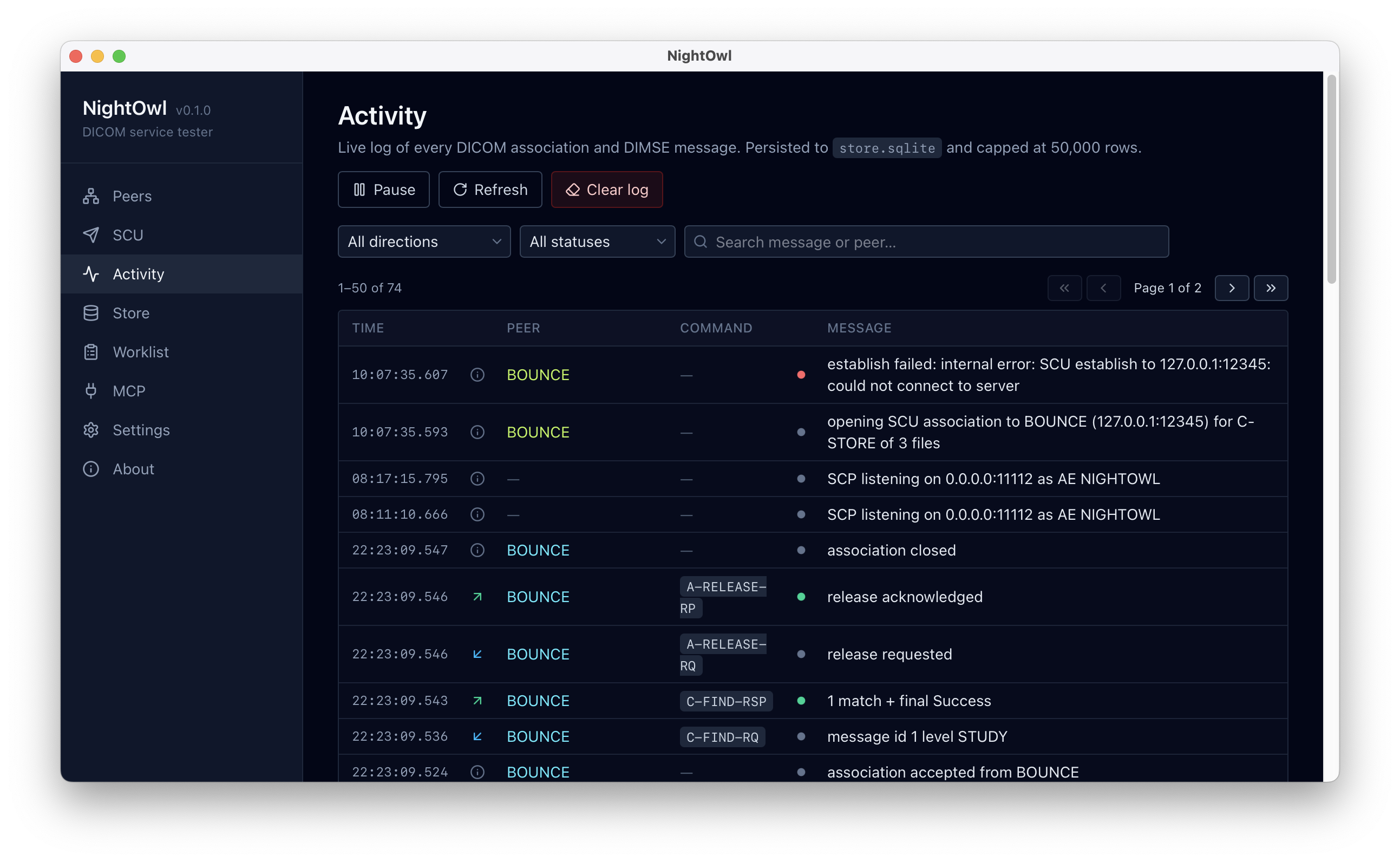
If you've ever built a DICOM integration, you know the drill. You need to test a C-STORE flow, so you spin up a heavyweight PACS in a VM, configure half a dozen settings files, wrestle with AE Titles, and pray the networking gods are feeling generous. All to send a single echo.
We built NightOwl because we were tired of that drill ourselves.
What is NightOwl?
NightOwl is a free, cross-platform desktop app that puts five core DICOM capabilities behind a single sidebar UI — no account required, no licence key, no ceremony:
- DICOM SCP — Accept inbound associations on a configurable port and AE Title. Verification, Patient/Study Root Q/R, and Modality Worklist FIND all work out of the box.
- DICOM SCU — C-ECHO, C-FIND, C-MOVE, and C-STORE with structured, inspectable results. Pick a peer, pick an operation, fill in the form, run.
- Local SOP Instance store — A directory on disk indexed in SQLite that behaves like a tiny PACS. Browse Patient → Study → Series → Instance and rescan on demand.
- Modality Worklist provider — Stand up a realistic worklist without dragging a full RIS into your test environment.
- Live activity log — Every association and every DIMSE message recorded with timestamp, peer, command, and status, streaming to the UI in real time.
It's built on Tauri 2, Rust, and React, using the dicom-rs crates under the hood — so you're exercising real DICOM, not a mock. It runs on Windows, Linux, and macOS.
The part we're most excited about: a built-in MCP server
There are command-line DICOM tools out there that do the protocol bits, and there are emerging MCP bridges for various services. NightOwl puts them together in a way we haven't seen anywhere else: a proper desktop app with an agent-drivable surface attached.
Flip on the optional local MCP server and NightOwl exposes 14 typed tools — 10 read tools (peers, studies, series, instances, activity, worklist, config) and 4 active SCU tools (scu_echo, scu_find, scu_move, scu_store). Point Claude Code or any spec-compliant MCP client at it and your agent can query peers, send DIMSE, inspect the activity log, and browse your local store — all through natural language.
$ claude mcp add nightowl \
    --transport http \
    http://127.0.0.1:7300/mcp

✓ NightOwl registered
  14 tools available

$ claude "ping all my peers and report"
Tool schemas are generated by schemars, so every MCP client gets a fully typed surface automatically. No docs to read, no glue to write.
The kinds of things you can just say out loud:
- "C-ECHO every peer and tell me which ones are down."
- "Find all studies for patient SMITH^JOHN on the staging PACS."
- "Send these three test DICOMs to the new integration."
- "Show me failed associations from the last hour and summarise the errors."
- "Pull all the CTs for accession 12345 from the remote PACS into my local store."
Click through the GUI when you want to see what's happening. Prompt through it when you want to automate. Both work, same window.
Who is it for?
- Integration engineers — Test C-STORE, C-FIND, and C-MOVE flows against your service without spinning up a full PACS. Inspect every DIMSE message live in the activity log.
- PACS administrators — Sanity-check routing rules, AE Title configuration, and worklist behaviour with a portable, scriptable peer that runs on your laptop.
- AI and MCP tinkerers — Wire DICOM into your agent stack. NightOwl's MCP surface turns complex multi-step DICOM workflows into one-line prompts.
Honest about scope
NightOwl is a developer and integration-testing tool. It is not a clinical product and makes no compliance claims. There's no TLS or authentication on the DICOM listener or MCP server — use it on a trusted local network. We'd rather be upfront about what it is than waste your time discovering what it isn't.
What it is: a free, single-window desktop app built on real DICOM crates, with hot reload on settings so you can change ports or AE Titles without restarting.
Download NightOwl
NightOwl is free for anyone building against DICOM. No account, no strings.
NightOwl is made by Aurabox, a cloud-based platform for sharing medical imaging. If you're interested in how organisations share imaging securely and instantly — replacing CDs, faxes, and phone calls — request a demo or sign up free.